
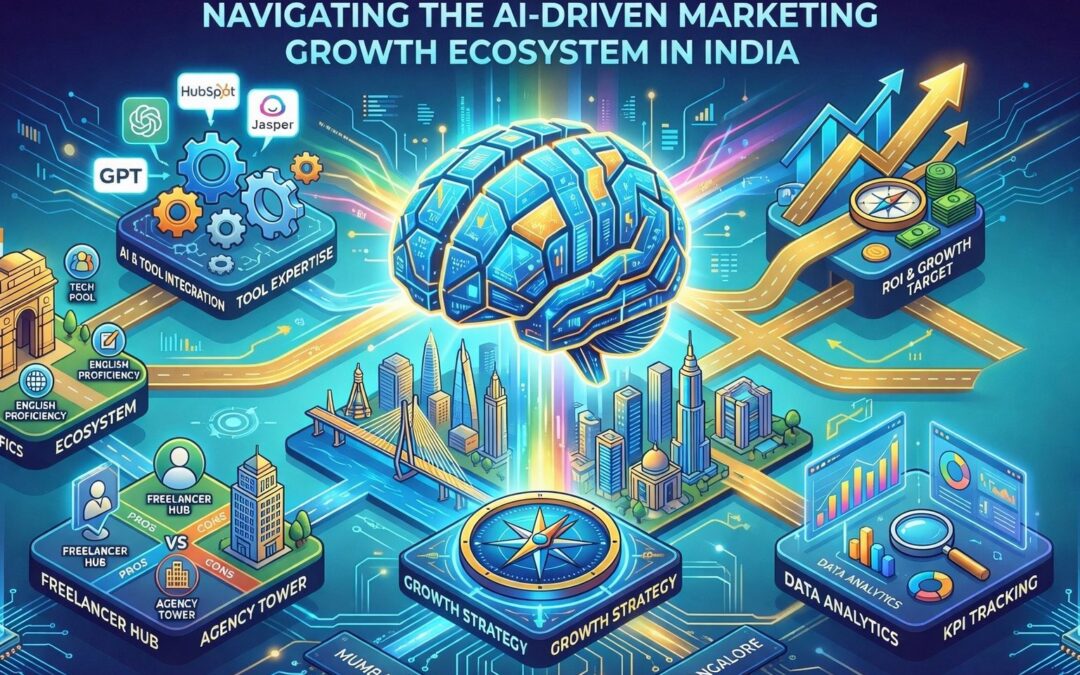
Quick Answer: To choose the best AI-driven digital marketing growth strategist in India, look for someone who combines proven AI tool expertise with real business results. They should understand data analytics, automation, content strategy, and paid media — all powered by AI. Check their portfolio, client reviews, certifications, and whether their strategy matches your business goals. The right strategist does not just use AI as a buzzword — they use it to grow your revenue.
Contents
- 1 Table of Contents
- 2 1. What Is an AI-Driven Digital Marketing Growth Strategist?
- 3 2. Why India Is a Hub for AI-Driven Marketing Talent
- 4 3. Key Skills to Look for in an AI-Driven Digital Marketing Strategist
- 5 4. How to Evaluate a Strategist’s AI Tool Expertise
- 6 5. Red Flags to Watch Out For
- 7 6. Questions to Ask Before You Hire
- 8 7. The Role of Data and Analytics in AI Marketing
- 9 8. How AI Changes SEO, Content, and Paid Ads Strategy
- 10 9. Pricing: What Does a Good AI Marketing Strategist Cost in India?
- 11 10. Freelancer vs. Agency vs. In-House: Which Is Right for You?
- 12 11. How to Verify Results and Track ROI
- 13 12. Top Platforms to Find AI-Driven Marketing Strategists in India
- 14 13. Case Studies: What Good AI-Driven Marketing Looks Like
- 15 14. Checklist Before You Hire
- 16 15. Final Thoughts
- 17 Frequently Asked Questions (FAQs)
- 17.1 What does an AI-driven digital marketing growth strategist do?
- 17.2 How is an AI-driven strategist different from a regular digital marketer?
- 17.3 How much does it cost to hire an AI marketing strategist in India?
- 17.4 How do I know if a strategist is actually using AI or just claiming to?
- 17.5 Can a small business benefit from an AI-driven marketing strategist?
- 17.6 What AI tools should a good marketing strategist know?
- 17.7 How long does it take to see results from AI-driven marketing?
- 17.8 Should I hire a freelancer or an agency for AI-driven marketing?
- 17.9 What questions should I ask when interviewing a digital marketing strategist?
- 17.10 Is AI going to replace digital marketing strategists?
Table of Contents
- What Is an AI-Driven Digital Marketing Growth Strategist?
- Why India Is a Hub for AI-Driven Marketing Talent
- Key Skills to Look for in an AI-Driven Digital Marketing Strategist
- How to Evaluate a Strategist’s AI Tool Expertise
- Red Flags to Watch Out For
- Questions to Ask Before You Hire
- The Role of Data and Analytics in AI Marketing
- How AI Changes SEO, Content, and Paid Ads Strategy
- Pricing: What Does a Good AI Marketing Strategist Cost in India?
- Freelancer vs. Agency vs. In-House: Which Is Right for You?
- How to Verify Results and Track ROI
- Top Platforms to Find AI-Driven Marketing Strategists in India
- Case Studies: What Good AI-Driven Marketing Looks Like
- Checklist Before You Hire
- FAQs
1. What Is an AI-Driven Digital Marketing Growth Strategist?
A digital marketing growth strategist helps businesses grow online. But an AI-driven one goes further.
They use artificial intelligence tools to speed up research, improve targeting, automate repetitive tasks, and make smarter decisions with data. Instead of guessing what works, they use AI to find patterns, test ideas fast, and scale what delivers results.
Think of them as a traditional marketing expert who has upgraded their entire toolkit. They still understand branding, customer psychology, and campaign strategy. But now they also use tools like ChatGPT for content, Jasper for copywriting, Semrush or Surfer SEO for keyword research, and platforms like HubSpot, Salesforce, or Marketo for automation.
Their job is simple: grow your business. They do that by using AI to work faster, target better, and waste less of your budget.
The Difference Between a Digital Marketer and a Growth Strategist
A digital marketer executes tasks. They write blogs, run ads, post on social media.
A growth strategist thinks at a higher level. They ask: “Where is the business losing money? Where is the biggest growth opportunity? What data tells us what to do next?” Then they build a system — often powered by AI — to capture that growth.
An AI-driven growth strategist combines both: strategic thinking and AI-powered execution.
2. Why India Is a Hub for AI-Driven Marketing Talent
India has one of the largest pools of digital marketing professionals in the world. Cities like Bangalore, Hyderabad, Mumbai, Pune, Delhi, and Chennai are producing thousands of trained marketers every year.
Here is why India stands out specifically for AI-driven marketing:
Strong tech background. India’s IT industry is world-class. Many digital marketers here come from an engineering or data science background. They understand AI tools at a deeper level than marketers from other regions.
Cost advantage. You get premium-quality work at a fraction of what you would pay in the US, UK, or Australia. A senior AI-driven strategist in India may cost 40–70% less than an equivalent professional in Western markets, without compromising quality.
English proficiency. India ranks among the highest English-speaking countries in the world. Communication is smooth for international clients.
Growing AI adoption. India’s startup ecosystem is booming. Marketers here are often early adopters of AI tools because their clients — especially funded startups — demand it.
Certifications and training. Indian professionals are among the most certified globally. Google, Meta, HubSpot, and Coursera certifications are common. Many have also completed AI-specific courses from platforms like Udemy, LinkedIn Learning, and NASSCOM.
If you are looking for an AI-driven digital marketing growth strategist — whether you are a business based in India or an international company looking to hire remotely — India gives you access to a large, skilled, and affordable talent pool.
3. Key Skills to Look for in an AI-Driven Digital Marketing Strategist
Not every person who calls themselves an “AI marketing strategist” actually knows what they are doing. Here is what a genuinely skilled professional should be able to demonstrate:
Strategic Thinking
AI tools are only useful if the person using them thinks clearly about business goals. Look for someone who starts with “What problem are we solving?” before jumping into tactics.
Data Literacy
They must be comfortable reading and interpreting data. Google Analytics 4, Meta Ads Manager reports, search console data, heatmaps — they should make sense of all of this and turn data into decisions.
AI Tool Proficiency
This is non-negotiable. They should be fluent in tools like:
- ChatGPT or Claude — for content ideation and drafting
- Jasper or Copy.ai — for high-volume copywriting
- Semrush, Ahrefs, or Surfer SEO — for AI-assisted keyword research and on-page optimization
- Canva AI or Adobe Firefly — for visual content creation
- HubSpot or Marketo — for AI-powered email and marketing automation
- Google Performance Max — for AI-optimized ad campaigns
- Notion AI or ClickUp AI — for project management and workflows
SEO and Content Strategy
Organic growth is still the most cost-effective channel. A good strategist understands how to use AI to build content that ranks, attracts the right audience, and converts.
Paid Media Knowledge
Knowing how to run profitable campaigns on Google Ads, Meta Ads, LinkedIn, and YouTube — with AI optimization built in — is a major asset.
Conversion Rate Optimization (CRO)
Getting traffic is only half the job. They should know how to use AI tools like Hotjar, Microsoft Clarity, and A/B testing platforms to improve how many visitors actually become customers.
Communication and Reporting
They must explain their work clearly. If they cannot tell you what they did and why it worked, that is a problem.
4. How to Evaluate a Strategist’s AI Tool Expertise
Lots of people list “AI marketing” on their LinkedIn profile. Fewer actually know what they are doing. Here is how to separate the real ones from those who just use the term to sound modern:
Ask for specific examples. “Tell me about a campaign where you used an AI tool. What tool did you use? What problem did it solve? What was the result?” Vague answers mean shallow knowledge.
Give a small test project. Ask them to do a quick audit of your website or a competitor analysis using AI tools. See what tools they choose and how they present findings.
Check their content. Do they write or post about AI marketing online? A genuine expert usually shares knowledge publicly — through LinkedIn articles, YouTube videos, or a blog.
Ask about tool limitations. A real expert will tell you what AI tools cannot do. If someone says AI can do everything perfectly, they are overselling. The best strategists know where AI helps and where human judgment still wins.
Look for tool certifications. HubSpot, Google, Meta, and Semrush all offer certifications. These are not a guarantee of skill, but they show commitment to learning.
5. Red Flags to Watch Out For
Hiring the wrong person wastes money and time. Watch for these warning signs:
They guarantee specific rankings or results. No one can guarantee a #1 Google ranking. Anyone who does is either lying or does not understand how search engines work.
They cannot explain their strategy in simple terms. If you ask “How will this campaign help my business grow?” and they respond with jargon that does not answer your question, that is a red flag.
They rely on one channel only. Real growth comes from a multi-channel strategy. If someone only talks about social media or only about SEO, they are not thinking broadly enough.
They do not ask about your business goals. A good strategist wants to understand your revenue model, target customers, and competitive landscape before recommending anything.
They have no measurable case studies. “We helped a brand grow” means nothing. “We grew organic traffic by 140% in six months” with data to back it is what you want.
They use AI as a buzzword only. If they say they “use AI” but cannot name specific tools or explain how, they are just following a trend, not actually applying it.
They overpromise on timeline. Sustainable growth takes time. A strategist promising explosive results in 30 days is likely using risky black-hat tactics that can hurt you long-term.
6. Questions to Ask Before You Hire
Use these questions in your initial conversation or interview:
- Can you walk me through a growth campaign you led using AI tools? What was the business problem, what did you do, and what were the results?
- Which AI tools do you use most, and why do you prefer them over alternatives?
- How do you stay updated with changes in AI marketing tools and Google’s algorithm?
- How do you measure success? What KPIs do you track?
- How do you handle a campaign that is not performing well?
- What does your onboarding process look like for a new client?
- How often do you report results, and what does a typical report include?
- What industries have you worked in? Do you have experience in my niche?
- How do you balance AI automation with original human thinking in your strategy?
- What is your process for understanding a client’s brand voice before using AI content tools?
The answers to these questions will tell you a lot. Pay attention to how specific they are, how honest they sound, and whether they genuinely seem curious about your business.
7. The Role of Data and Analytics in AI Marketing
AI is only as powerful as the data feeding it. A great AI-driven strategist is obsessed with data. Here is how they use it:
Customer Behavior Data
They analyze how users interact with your website, what pages they visit, where they drop off, and what content gets the most engagement. Tools like Google Analytics 4, Hotjar, and Microsoft Clarity give deep behavioral insights.
Audience Segmentation
AI allows marketers to segment audiences far more precisely than before. Instead of targeting “women aged 25–40,” an AI-driven strategist might target “women aged 28–35 in metro cities who have shown interest in sustainable fashion and searched for eco-friendly brands in the last 30 days.”
Predictive Analytics
Advanced AI tools can predict which leads are most likely to convert, which customers are at risk of churning, and which ad creatives will perform best before you even launch a campaign. This saves budget and increases returns.
Attribution Modeling
Good strategists understand attribution — knowing which touchpoints actually contributed to a conversion. Multi-touch attribution models, powered by AI, give a more accurate picture of what is driving revenue.
Content Performance Analysis
AI tools can analyze which blog posts, videos, or social content is generating the most qualified traffic and conversions. This tells the strategist where to invest more content resources.
A strategist who is not comfortable with data is like a chef who does not taste the food. Data is how they know if the strategy is working.
8. How AI Changes SEO, Content, and Paid Ads Strategy
AI has fundamentally shifted how marketing works. Here is what it means for each major channel:
SEO in the Age of AI
Google’s AI-powered Search Generative Experience (SGE) means the way people search is changing. Instead of ten blue links, users now see AI-generated summaries at the top of the page.
A skilled AI-driven strategist optimizes for both traditional SEO and AI answer engines. This means:
- Writing content that directly answers questions (AEO — Answer Engine Optimization)
- Using structured data and schema markup so AI can read content easily
- Building topical authority across a subject, not just targeting individual keywords
- Optimizing for voice search with natural, conversational language
- Creating content that satisfies search intent at every stage of the buyer journey
They also use AI tools like Surfer SEO, Frase, or MarketMuse to identify content gaps and build a strategy that systematically captures organic traffic.
Content Strategy Powered by AI
AI has dramatically lowered the cost and time needed to produce content. But quantity without quality is worthless.
A smart strategist uses AI to generate first drafts, surface topic ideas, research competitors, and identify what questions their audience is actually asking. Then they apply human editing, brand voice, and strategic thinking to make that content genuinely useful.
The result: more content, produced faster, without sacrificing depth or authenticity.
Paid Advertising with AI
Google’s Performance Max and Meta’s Advantage+ campaigns are entirely AI-optimized. They automatically allocate budget, choose placements, and adjust targeting in real time.
But they still need a smart human to set them up correctly. A skilled strategist knows:
- How to structure campaigns so the AI has good signals to learn from
- What creative inputs (images, headlines, descriptions) to feed the algorithm
- How to set conversion goals that actually reflect business outcomes
- When to trust the AI and when to intervene manually
They also know how to use AI for ad creative testing, audience analysis, and performance forecasting.
9. Pricing: What Does a Good AI Marketing Strategist Cost in India?
Pricing varies significantly depending on experience, specialization, and whether you hire a freelancer, agency, or in-house professional.
Here is a rough guide as of 2025:
Freelancer (Junior to Mid-Level): INR 15,000–50,000 per month. Suitable for small businesses with limited budgets. Quality varies widely. Vet carefully.
Freelancer (Senior/Expert): INR 60,000–1,50,000 per month. A genuine AI-driven expert with a track record. Worth it for businesses serious about growth.
Boutique Agency: INR 50,000–2,50,000 per month. You get a team instead of one person. Good for businesses that need multi-channel execution.
Large Digital Marketing Agency: INR 2,00,000 and above per month. Full-service with dedicated account managers. Suitable for enterprise clients or brands with large ad budgets.
Project-Based Pricing: INR 20,000–1,00,000 for a one-time project like a full website audit, SEO strategy document, or campaign setup.
Do not choose based on price alone. The cheapest option often costs more in the long run due to poor results and lost opportunities. Focus on ROI — what revenue growth can you expect compared to what you are paying?
Always ask for a breakdown of what is included in the pricing. Retainer fees should clearly define deliverables: How many hours per week? What channels are covered? What does reporting look like?
10. Freelancer vs. Agency vs. In-House: Which Is Right for You?
Each option has trade-offs. Here is how to think about them:
Hiring a Freelancer
Best for: Early-stage startups, small businesses, businesses testing a specific channel.
Pros: Lower cost, direct communication, flexible engagement.
Cons: Limited bandwidth, may lack expertise across all channels, no backup if they get sick or leave.
What to look for: Specialization in your industry or channel, verifiable track record, clear process.
Hiring an Agency
Best for: Growing businesses that need full-service support across multiple channels.
Pros: Team of specialists, established processes, scalable.
Cons: Higher cost, less personalized attention (especially at larger agencies), slower communication.
What to look for: Agency specialization in AI-driven marketing (not just traditional digital marketing), transparent reporting, case studies in your industry.
Building In-House
Best for: Established businesses with recurring, high-volume marketing needs.
Pros: Full control, deep brand knowledge, faster communication.
Cons: High fixed cost (salary + benefits + tools), time-consuming to hire and onboard, risk if the person leaves.
What to look for: Cultural fit, learning mindset, hands-on experience with AI tools.
Many businesses use a hybrid model — one in-house strategist supported by freelancers or agencies for specific channels or tasks.
11. How to Verify Results and Track ROI
Before hiring anyone, agree on how success will be measured. Here is how to track ROI from AI-driven marketing:
Set clear KPIs upfront. Examples: organic traffic growth, cost per lead, lead-to-customer conversion rate, monthly revenue from digital channels, email open rates, ROAS (return on ad spend).
Use a shared analytics dashboard. Tools like Google Data Studio (Looker Studio), HubSpot, or Databox can combine data from all channels into one live dashboard. Both you and the strategist should have access.
Review reports monthly. A good strategist sends a monthly report that explains what was done, what the results were, and what will be done next. It should include both numbers and commentary.
Ask for attribution data. You want to know which marketing activities are actually driving revenue, not just which ones are getting clicks.
Compare against benchmarks. Ask your strategist how your performance compares to industry averages. If your cost per lead is three times the industry average, that needs to be addressed.
Run quarterly strategy reviews. Every three months, sit down with your strategist and reassess. What is working? What is not? What should change?
ROI from marketing is not always immediate — especially for SEO and content, which take 3–6 months to build momentum. Paid ads can show results faster. Be realistic about timelines and set expectations early.
12. Top Platforms to Find AI-Driven Marketing Strategists in India
Here are the best places to find and hire qualified AI-driven digital marketing strategists in India:
LinkedIn: The most reliable platform for professional hiring. Use search filters to find candidates with specific skills like “AI marketing,” “growth strategy,” “SEO,” or “performance marketing.” Check their activity — do they post about AI marketing? That is a strong signal.
Upwork: Large freelancer marketplace with detailed profiles, reviews, and portfolios. Use the search to filter by skills and look for candidates with high job success scores and specific AI tool experience.
Naukri.com and Shine.com: India’s largest job portals. Good for finding candidates open to full-time roles.
Internshala: Good for finding young but talented individuals early in their career, often at lower cost.
TopHire and Hirist: Niche platforms focused on tech and digital marketing talent in India.
Clutch.co: Best for finding and vetting marketing agencies. Read detailed client reviews, look at case studies, and compare agencies by industry focus.
Referrals: Do not underestimate word of mouth. Ask other founders, business owners, or your professional network. A referred candidate comes with a trust signal already attached.
When evaluating profiles on any platform, look for: specific tools mentioned, quantified results (percentages, numbers), case studies or portfolio links, client testimonials, and how they describe their process.
13. Case Studies: What Good AI-Driven Marketing Looks Like
Understanding what results are realistic helps you set the right expectations. Here are fictional but realistic examples based on common outcomes in Indian markets:
Case Study 1: D2C Fashion Brand in Mumbai
A direct-to-consumer fashion brand was spending heavily on paid ads but seeing diminishing returns. They hired an AI-driven growth strategist who:
- Used AI tools to identify their highest-value customer segments
- Rebuilt their Google Performance Max campaigns with better creative assets
- Created an SEO content strategy targeting long-tail fashion queries
- Set up AI-powered email flows to recover abandoned carts
Result: Over six months, their cost per acquisition dropped by 38%, organic traffic grew by 90%, and email revenue increased by 65%.
Case Study 2: B2B SaaS Startup in Bangalore
A B2B software startup struggled to generate qualified leads. Their new AI-driven strategist:
- Conducted an AI-powered competitor analysis to identify content gaps
- Built a LinkedIn content strategy targeting CXOs and decision-makers
- Created SEO-optimized long-form content targeting bottom-funnel keywords
- Used HubSpot automation to nurture leads through a sales funnel
Result: In four months, qualified inbound leads doubled, the average deal cycle shortened, and cost per qualified lead dropped by 45%.
Case Study 3: EdTech Company in Hyderabad
An EdTech company wanted to scale enrollment. Their strategist:
- Used AI to analyze student journey data and find drop-off points
- Ran A/B tests on landing pages using AI-generated headline variants
- Launched video ad campaigns with AI-optimized targeting on YouTube and Instagram
- Built a content hub answering common student queries to capture organic traffic
Result: Enrollment grew by 75% over eight months while ad spend remained flat.
These outcomes are achievable. But they require the right combination of strategic thinking, AI tools, and consistent execution.
14. Checklist Before You Hire
Use this checklist to make sure you are making the right decision:
- They have a clear, documented strategy process
- They can name specific AI tools they use and explain how
- They have case studies with measurable results
- Their references or reviews are verifiable
- They ask about your business goals before recommending anything
- They are transparent about pricing and what is included
- They set realistic expectations on timelines
- They propose a reporting structure with clear KPIs
- They understand your industry or are willing to research it deeply
- You feel you can communicate openly with them
- Their contract includes clear deliverables and exit terms
- They are up to date with AI tools, Google algorithm changes, and platform updates
If a candidate checks most of these boxes, they are likely a strong fit. No one will check every box perfectly — focus on the most critical ones: track record, AI expertise, strategic thinking, and communication.
15. Final Thoughts
Choosing the best AI-driven digital marketing growth strategist in India is not just about finding someone who knows the latest tools. It is about finding a thinker who uses those tools to solve real business problems.
India has exceptional talent in this space. But the market also has a lot of noise — people who have learned the vocabulary of AI marketing without building real expertise.
Do your research. Ask the right questions. Verify results. Start with a small project before committing to a long-term retainer.
The right strategist will not just manage your marketing. They will become a growth partner who helps your business reach its next stage.
Frequently Asked Questions (FAQs)
What does an AI-driven digital marketing growth strategist do?
They use artificial intelligence tools combined with strategic marketing thinking to grow a business online. Their work includes SEO, paid advertising, content strategy, email marketing, data analysis, and automation — all powered by AI to work faster and more effectively.
How is an AI-driven strategist different from a regular digital marketer?
A regular digital marketer focuses on executing tasks — writing posts, running ads, building emails. An AI-driven growth strategist focuses on the bigger picture: identifying growth opportunities, using data to make decisions, and using AI tools to scale what works and cut what does not.
How much does it cost to hire an AI marketing strategist in India?
Costs range from INR 15,000 per month for a junior freelancer to INR 1,50,000 or more per month for a senior expert. Agencies typically charge between INR 50,000 and INR 2,50,000 per month depending on the scope of work.
How do I know if a strategist is actually using AI or just claiming to?
Ask them to demonstrate specific tools during your conversation. Ask for examples of past campaigns where AI was used. Look at their work samples and reports. A real expert will be comfortable showing their process, not just describing it in vague terms.
Can a small business benefit from an AI-driven marketing strategist?
Yes. AI tools have made sophisticated marketing strategies more accessible and affordable. Small businesses can benefit from AI-driven SEO, automated email campaigns, and optimized paid ads — all of which can be managed by a single skilled strategist without a large team.
What AI tools should a good marketing strategist know?
At minimum, they should be familiar with tools in the following categories: content creation (ChatGPT, Jasper), SEO (Semrush, Ahrefs, Surfer SEO), paid ads (Google Performance Max, Meta Advantage+), automation (HubSpot, Mailchimp), analytics (Google Analytics 4, Looker Studio), and visual content (Canva AI, Adobe Firefly).
How long does it take to see results from AI-driven marketing?
Paid advertising can show early results within 1–4 weeks. SEO and content marketing typically take 3–6 months to build meaningful organic traffic. Email and automation results appear within days to weeks depending on the size of the list. A good strategist will set realistic expectations from the start.
Should I hire a freelancer or an agency for AI-driven marketing?
It depends on your needs and budget. Freelancers are more cost-effective and offer direct communication. Agencies provide a full team and broader expertise. For small businesses, a senior freelancer or boutique agency is often the best balance of cost and quality.
What questions should I ask when interviewing a digital marketing strategist?
Focus on: specific past campaign results, which AI tools they use and why, how they measure success, how they handle underperforming campaigns, and what their reporting process looks like. Also ask about their experience in your industry.
Is AI going to replace digital marketing strategists?
No. AI is a tool, not a replacement for strategic thinking. The best AI-driven strategists use AI to work faster and smarter, but human judgment, creativity, and understanding of business context remain irreplaceable. AI amplifies the work of a great strategist — it does not replace them.
Contact us:https://saadhikacreates.com/, https://byzarinadigital.com/